
Product guidance
Orchestrating Identity: Integrating Phone Verification into AI Agent Workflows
Learn how to integrate phone-number insights and asynchronous verification into AI agent orchestration workflows for improved routing and data hygiene.
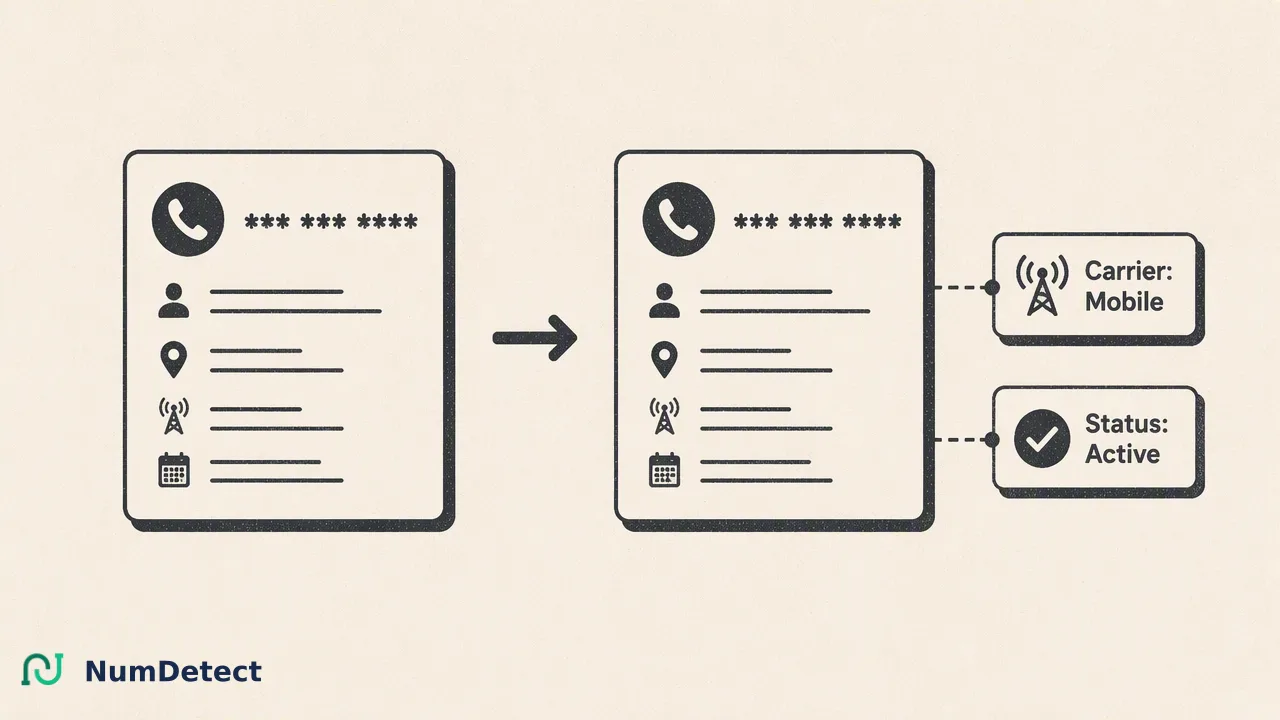
Learn how asynchronous bulk phone-number verification and carrier context integrate into AI agent orchestration workflows to improve routing, data hygiene, and human handoffs.
AI agent identity verification relies on harmonizing specialized agents to evaluate records, route interactions, and maintain shared contextual memory across workflows. While execution engines often run multi-agent patterns—such as sequential steps, parallel evaluations, or supervisor routing—their decisions depend entirely on data hygiene. Integrating asynchronous bulk phone-number insights allows organizations to clean, validate, and enrich contact records prior to agent engagement. By supplying agents with verified carrier context and activation signals, systems can prioritize operational queues, direct inquiries to specialized sub-agents, and reduce routing failures before handing complex exceptions to human teams.
The Role of Data in AI Agent Orchestration
AI agent orchestration organizes multiple autonomous models to complete complex operational goals. Instead of deploying a single monolithic prompt, teams structure agents into defined patterns, such as sequential chains, parallel task runners, or centralized supervisor models. In these architectures, agents dynamically interpret input, consult external tools, and route tasks according to specific rules. However, autonomous agents can struggle with incomplete records or fragmented context, leading to inaccurate task routing or redundant inquiries. Supplying reliable data signals serves as a foundational layer for these systems. When orchestrating customer communications or onboarding workflows, agents require verified operational context to determine which branch of logic to execute. Upfront data hygiene helps keep agent memory synchronized across tasks, reducing misdirected handoffs and ensuring downstream agents operate with consistent record attributes.
Phone-Number Insights as a Gatekeeper Agent
Within an orchestration pattern, verification often functions as a specialized gatekeeper agent that evaluates incoming data before downstream tasks trigger. Rather than executing expensive downstream actions on unverified inputs, the supervisor agent delegates validation checks to specialized tools. For instance, Global Carrier Detection returns carrier information for phone-number record review, which helps agents route inquiries to regional handling teams or specific telecommunication queues. Similarly, Phone Number Validation returns an activation signal that supports list hygiene and queue prioritization, helping workflows flag unallocated or non-working numbers. Incorporating separate signals, such as Number Activity, provides operational context for ranking batch interactions without inferring online status. By checking these data points at the start of a sequence, the orchestration model can branch cleanly, reserving automated communication resources for viable records while routing anomalies into alternative paths.
Integrating Asynchronous Workflows into AI Architectures
While some agent reasoning occurs during live interactions, enterprise data preparation often benefits from asynchronous bulk workflows. Platforms like NumDetect process large datasets in the background, preparing batch records for cleaning, segmentation, and CRM enrichment before agents query them. In this architecture, technical teams submit batches of 1,000 to 100,000 numbers formatted in TXT or CSV files along with an ISO country code via POST /api/v1/bulk-tasks. The task status is monitored through GET /api/v1/bulk-tasks/{id}, cycling through processing, success, or failed states. Mainland China numbers are not supported in this workflow. Once enriched, the resulting carrier and activation signals are stored within the centralized operational database or vector memory. When an AI agent initiates an interaction, it retrieves pre-processed signals instantly from shared memory, bypassing the latency of synchronous external lookups while preventing context loss across agent handoffs.
Managing Human Handoffs and Exceptions
Automated workflows cannot resolve every edge case, making structured escalation paths essential to AI orchestration. When an agent encounters ambiguous signals, missing data, or an inactive record during workflow execution, it must decide whether to continue, re-route, or escalate. Unresolved verification checks act as an automatic trigger for human handoffs. Because the orchestration layer maintains a shared context across tools, the agent passes the complete interaction history alongside the underlying phone insights to the human representative. This structured handoff ensures human reviewers do not duplicate automated inquiries or ask customers for data already evaluated. Furthermore, teams can use bulk activation and activity signals to prioritize human review queues, directing complex exceptions to senior operators while lower-risk discrepancies remain with automated supervisory agents. This division of labor keeps human intervention focused where contextual judgment is most valuable.
FAQ
How do AI agents use phone-number signals for routing?
AI agents use phone-number signals, such as carrier detection and activation status, to inform internal workflow routing rules. In a supervisor orchestration architecture, the coordinating agent evaluates the record context to direct inquiries toward appropriate regional teams or specialized sub-agents. This structured data helps the system avoid misdirected handoffs and keeps downstream agents focused on viable, properly categorized records.
Why is asynchronous bulk processing preferred for large-scale AI agent datasets?
Asynchronous bulk processing is well suited for large datasets because it enriches thousands of records without introducing real-time latency into individual agent execution loops. By processing lists of 1,000 to 100,000 numbers in the background, teams update their central CRM or agent memory in advance, ensuring agents reference pre-verified data immediately during multi-step orchestration workflows.
How can data hygiene improve the performance of AI orchestration models?
Reliable data hygiene establishes a clean contextual foundation across multi-agent workflows. When autonomous agents operate on outdated or invalid records, they risk making faulty routing decisions, losing state across task transitions, or triggering unnecessary escalations. Systematically validating phone records helps maintain consistent shared memory, reducing agent confusion and ensuring human handoffs are reserved for genuine operational exceptions.
Learn More
Choose the product information that fits the next step in your workflow.