
Product guidance
Why AI Voice Agent Fraud Prevention Requires Upstream Caller Intelligence
Learn how bulk phone-number intelligence and carrier signals strengthen AI voice agent fraud prevention by cleaning static records before outbound dialing.
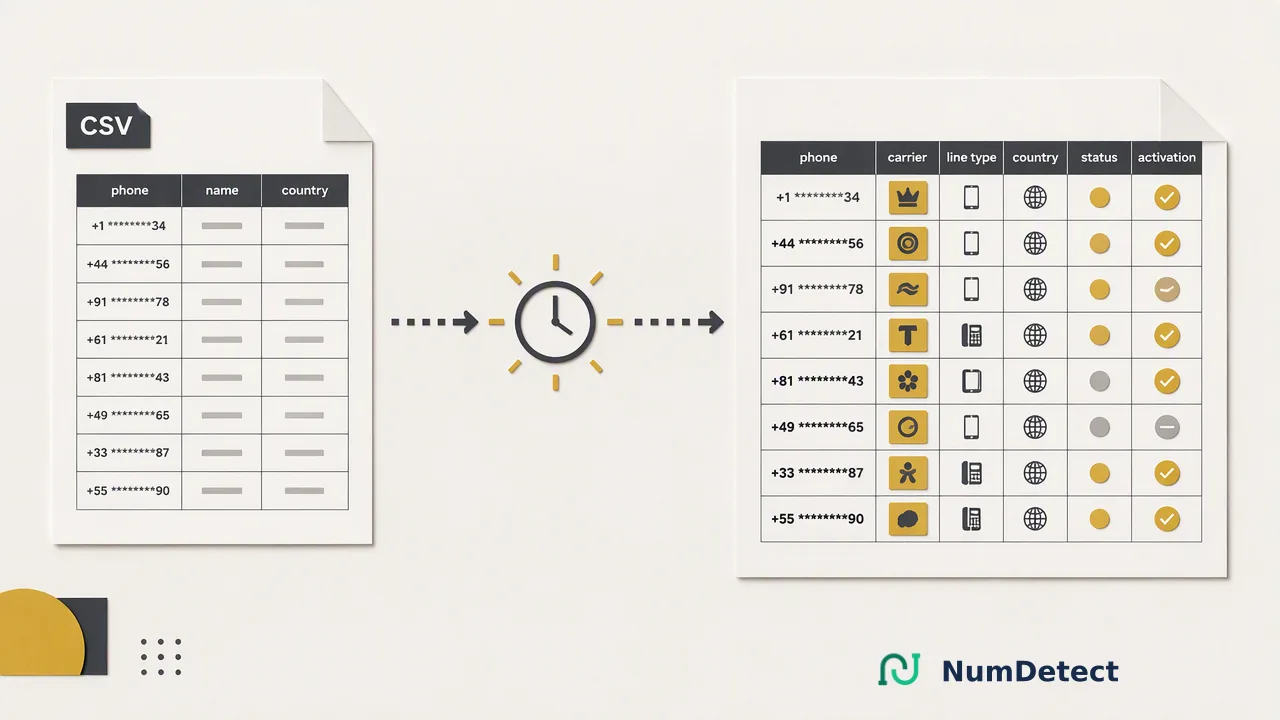
AI voice agents depend on clean contact data. Learn how pre-call bulk phone-number validation and carrier signals help teams mitigate fraud risks, eliminate inactive records, and protect conversational agent infrastructure.
Deploying conversational AI without verifying underlying contact data introduces operational friction and risk. Outdated or synthetic numbers expose automated voice agents to dead air, misallocated compute resources, and abusive automated answering loops. While live call monitoring exists, robust AI voice agent fraud prevention starts upstream with foundational contact hygiene. By running list screening through asynchronous bulk phone-number intelligence, technical teams can evaluate carrier context and activation signals before deploying calling workflows. Pre-processing contact repositories helps organizations segment audiences, suppress invalid lines, and ensure outbound agents focus on verified, reachable records across automated voice campaigns.
The Data Infrastructure Gap in AI Voice Deployments
AI voice agents rely entirely on the quality and integrity of their data pipelines. When voice models ingest stale CRM records, technical teams face immediate operational vulnerabilities. Invalid lines waste valuable compute cycles, while unverified routing paths can expose outbound agents to bot traps, telephony abuse, and repetitive failure loops. In automated voice campaigns, an agent cannot intuitively discern whether an uncontacted number has been abandoned, converted into a high-risk routing endpoint, or reassigned. Addressing this gap requires treating phone data hygiene as an essential pre-processing step. System architectures that pass unchecked contact lists directly into conversational agent schedulers risk degraded service performance and distorted reporting metrics. Establishing an asynchronous data auditing workflow prior to queuing contact lists provides essential structural safeguards, filtering flawed records and helping systems allocate agent resources efficiently across large outbound operations.
Limitations of Static Contact Records in Dynamic Telephony
Customer contact data degrades continuously due to number churn, carrier switching, and decommissioned lines. Maintaining static contact databases without periodic verification exposes conversational voice systems to severe operational risks. Attackers frequently exploit this static vulnerability by routing AI voice agent interactions into unassigned prefixes, dead lines, or unmonitored voicemail loops designed to run up billable agent compute. Static datasets also fail to reflect shifts in line validity over time. When outbound schedulers dispatch automated calls to numbers that no longer exist, the AI agent spends valuable processing time executing initial call establishment and monitoring silence. Conducting scheduled bulk validation checks helps engineering teams identify and isolate deactivated numbers before an agent dials. Regularly refreshing bulk phone records cleans CRM repositories, minimizes unnecessary telephony requests, and informs risk models before outbound interaction begins.
Utilizing Global Carrier Detection for Risk Review
Contextual telephony metadata provides valuable operational intelligence for structuring voice agent rules. Through global carrier detection, teams can evaluate carrier information across large datasets during pre-call data preparation. Identifying line types—such as distinguishing mobile devices from landlines or virtual endpoints—helps organizations route voice interactions into appropriate agent queues. For instance, high-throughput automated conversational flows might prioritize mobile lines while routing non-standard carrier prefixes for human review or secondary checks. It is critical to recognize that carrier data serves as an operational review signal rather than a proof of subscriber identity. It does not reveal who holds the device or confirm caller intent. Instead, carrier context helps technical teams review record attributes, recognize non-standard routing environments, and support internal risk scoring before allocating high-cost AI voice resources to an outreach campaign.
Pre-Processing Contact Lists via Asynchronous Bulk Workflows
Handling large volumes of phone records requires scalable processing architectures that avoid the latency and rate overhead of live single-number endpoints. NumDetect provides an asynchronous bulk workflow specifically designed for reviewing large phone-number datasets prior to outreach. Engineering teams format list files containing between 1,000 and 100,000 numbers in TXT or CSV formats, submit them using POST /api/v1/bulk-tasks, and track execution via GET /api/v1/bulk-tasks/{id} across documented public states: processing, success, and failed. Tasks require an ISO country code and support global formats, excluding China mainland numbers. This batch approach decouples heavy contact hygiene from real-time agent execution, allowing systems to ingest verified activation and carrier signals in bulk. Processing data offline helps teams systematically cleanse operational databases, reduce infrastructure waste, and prioritize verified numbers before voice dispatch workflows launch.
Operational Cost Control Through Data Segmentation
Running AI voice agents incurs infrastructure costs across speech-to-text transcription, large language model generation, and audio streaming latency. Attempting to dial unvalidated or invalid numbers inflates these operational expenses without delivering customer contact. By segmenting contact lists using phone validation and activity signals, organizations can isolate high-risk or inactive records before queue generation. Phone validation returns documented activation signals that support list cleaning, while number activity signals inform operational prioritization and campaign ranking. Removing unserviceable lines prior to voice dispatch helps teams lower unnecessary telephony spend, focus computational resources on legitimate audiences, and enhance overall campaign efficiency.
FAQ
How does bulk phone validation support AI voice agent operations?
Bulk phone validation provides documented activation signals across large datasets, helping organizations screen unserviceable lines before deploying automated calling. This pre-processing step avoids wasting agent compute cycles and telephony resources on non-functional endpoints, supporting better pipeline performance.
Can carrier detection alone eliminate voice agent fraud?
No. Line type and network carrier details help teams assess operational risk and flag anomalous numbers for secondary review. Organizations should use carrier intelligence as one foundational input alongside internal risk rules, rather than relying on it as a deterministic guarantee.
Why use an asynchronous bulk workflow rather than live per-call lookups?
Asynchronous bulk workflows allow teams to clean and segment large repositories of 1,000 to 100,000 numbers without introducing latency into live calling infrastructure. Processing contact lists offline via bulk tasks gives teams verified carrier and activation signals beforehand. This decouples data hygiene from real-time agent dispatch, ensuring outbound campaigns execute against structured, pre-filtered records without per-call lookup overhead.
Learn More
Choose the product information that fits the next step in your workflow.