
Product guidance
How to Architect a Robust Phone Verification Workflow: A Developer’s Guide
Learn how to architect an asynchronous bulk phone verification workflow, structure task-based API requests, and integrate activation and carrier signals.
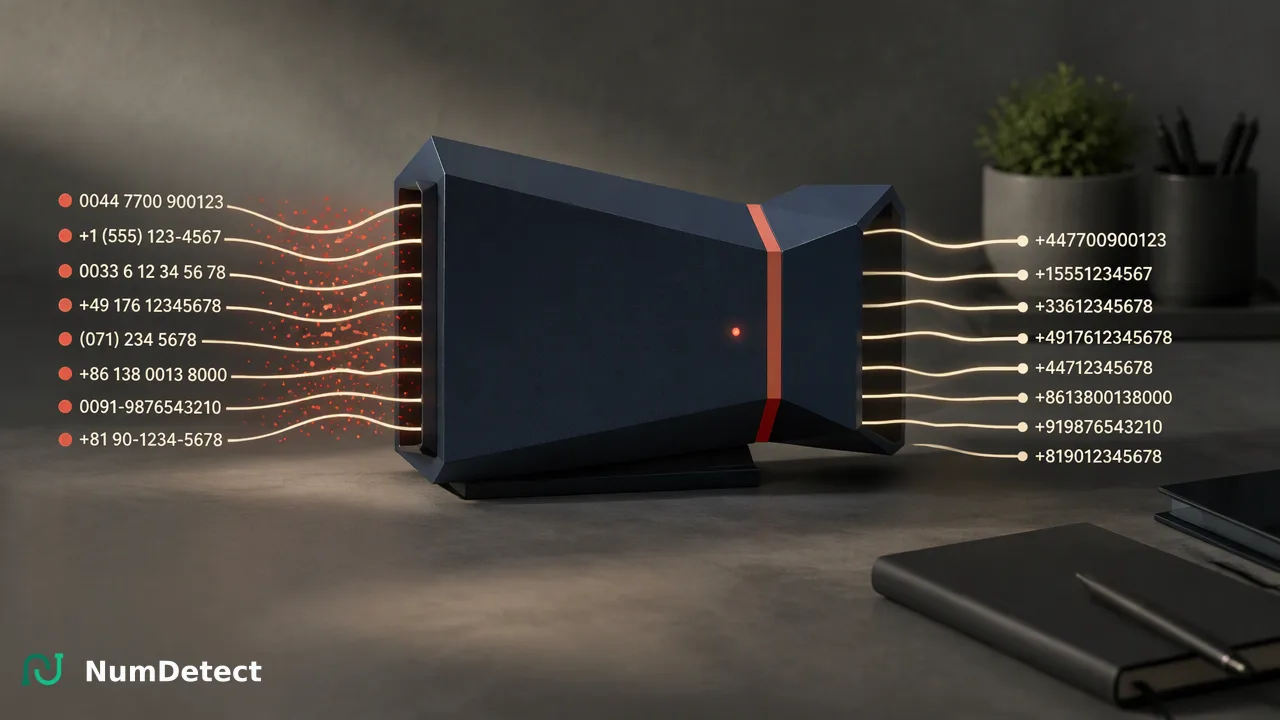
A technical guide for developers on architecting an asynchronous bulk phone verification workflow, designing task-based API lifecycles, and integrating activation, carrier, and activity signals.
Architecting a robust phone verification workflow requires moving from basic regex formatting to structured server-side data processing. For teams handling large contact lists, an asynchronous bulk architecture prevents bottlenecks by decoupling file ingestion from data retrieval. Using background tasks, engineers can validate activation status, capture carrier context, and incorporate activity signals across regional datasets before importing records into CRMs or routing pipelines. This guide explains how to define verification resources, manage asynchronous task lifecycles, normalize contact files into single-country batches, and interpret discrete data signals without assuming downstream message delivery or identity ownership.
Defining the Mission and Core Resources of Your Verification Architecture
Building an effective verification workflow starts by defining the integration's specific objective, such as cleansing CRM lists, optimizing message routing, or prioritizing outreach. Production systems cannot rely solely on client-side regular expressions, as syntax validation only checks string structure and cannot detect network activation or carrier assignment. Developers should first model the core resources—the nouns—of the verification domain: raw phone numbers, regional metadata, carrier context, and activity signals. Establishing distinct schemas for these resources early isolates formatting requirements from downstream enrichment. Defining clear boundaries between file preparation and signal enrichment helps engineering teams select appropriate backend processing strategies based on dataset scale and integration objectives.
Implementing the Asynchronous Bulk Task Lifecycle
Synchronous API endpoints struggle when processing thousands of contact records simultaneously, causing network timeouts and fragile integrations. A resilient architecture relies on an asynchronous bulk processing pattern that decouples task ingestion from result extraction. The client submits a prepared batch using POST /api/v1/bulk-tasks, which registers the job and returns a task identifier. Background workers process the list independently, while downstream systems query status via GET /api/v1/bulk-tasks/{id}, handling three explicit public states: processing, success, and failed. This decoupled pattern protects upstream services from latency spikes, handles batches of 500 to 500,000 records smoothly, and ensures network interruptions do not compromise pipeline execution.
Integrating Activation, Carrier, and Activity Signals
Robust verification systems treat signals as modular inputs rather than combining them into an opaque score. Each signal addresses a specific operational requirement:
| Signal Family | Primary Insight | Architectural Application |
|---|---|---|
| Phone Number Validation | Activation status | Filtering disconnected numbers from CRM pipelines |
| Global Carrier Detection | Carrier metadata | Informing regional routing and telco gateway selection |
| Number Activity | Engagement indicators | Segmenting records for operational prioritization |
| High-Value Users | Potential high-value signal | Audience segmentation based on device context |
Phone Number Validation provides an activation signal for database hygiene without guaranteeing message delivery. Global Carrier Detection supplies carrier context for record review rather than subscriber identity. Activity and high-value signals assist operational prioritization without reporting exact timestamps, user income, or verified intent.
Best Practices for Data Normalization and Regional Batching
Data preparation directly affects verification reliability. Input files should be formatted cleanly as TXT or CSV files containing one number per line, with dataset sizes constrained between 500 and 500,000 valid records per task. Applying E.164 normalization standards ensures numbers are stripped of local prefixes, hyphens, and whitespace before task submission. Furthermore, bulk processing tasks require segmentation by an ISO country or region code. Ingestion pipelines must sort international lists into single-region batches prior to submission. Pipelines must also recognize geographic boundaries: China mainland numbers are not supported in this bulk workflow and require separate handling. Finally, architectures should handle missing signal attributes neutrally, distinguishing absent records from negative findings to maintain data integrity.
FAQ
Why do technical teams prefer asynchronous processing for large phone datasets?
Asynchronous processing isolates batch ingestion from intensive background computation, preventing HTTP timeouts when evaluating thousands of records. Submitting files via POST /api/v1/bulk-tasks and polling via GET /api/v1/bulk-tasks/{id} allows systems to process batches between 500 and 500,000 numbers efficiently, tracking clear processing, success, and failed states without blocking client application services.
How do carrier detection signals support routing decisions?
Global Carrier Detection returns carrier context associated with phone-number records during bulk reviews. Systems use this context to inform telco gateway selection, audit regional routing paths, and segment databases. Carrier detection is an informational network signal rather than a subscriber-identity lookup, helping teams review carrier allocation without revealing subscriber ownership or account holder identities.
What is the difference between phone validation and activity signals?
Phone Number Validation returns an activation signal indicating whether a number is currently active, supporting CRM hygiene and list cleaning. In contrast, Number Activity provides a behavioral indicator used for record ranking and segmentation.
How should workflows handle unsupported regions like China mainland?
Bulk phone-number task workflows do not support China mainland numbers. Integration architectures must incorporate pre-submission filtering that validates the assigned ISO country code and isolates mainland Chinese numbers before file generation. Diverting unsupported records into separate internal review queues ensures bulk tasks comply with batch constraints and prevents task rejection during processing.
Learn More
Choose the product information that fits the next step in your workflow.