
Product guidance
Why Prefix-Based Validation Fails in Canada: Bulk Number Intelligence Guide
Discover why static prefix lookup fails in Canada due to wireless portability and how asynchronous bulk carrier detection supports contact list hygiene.
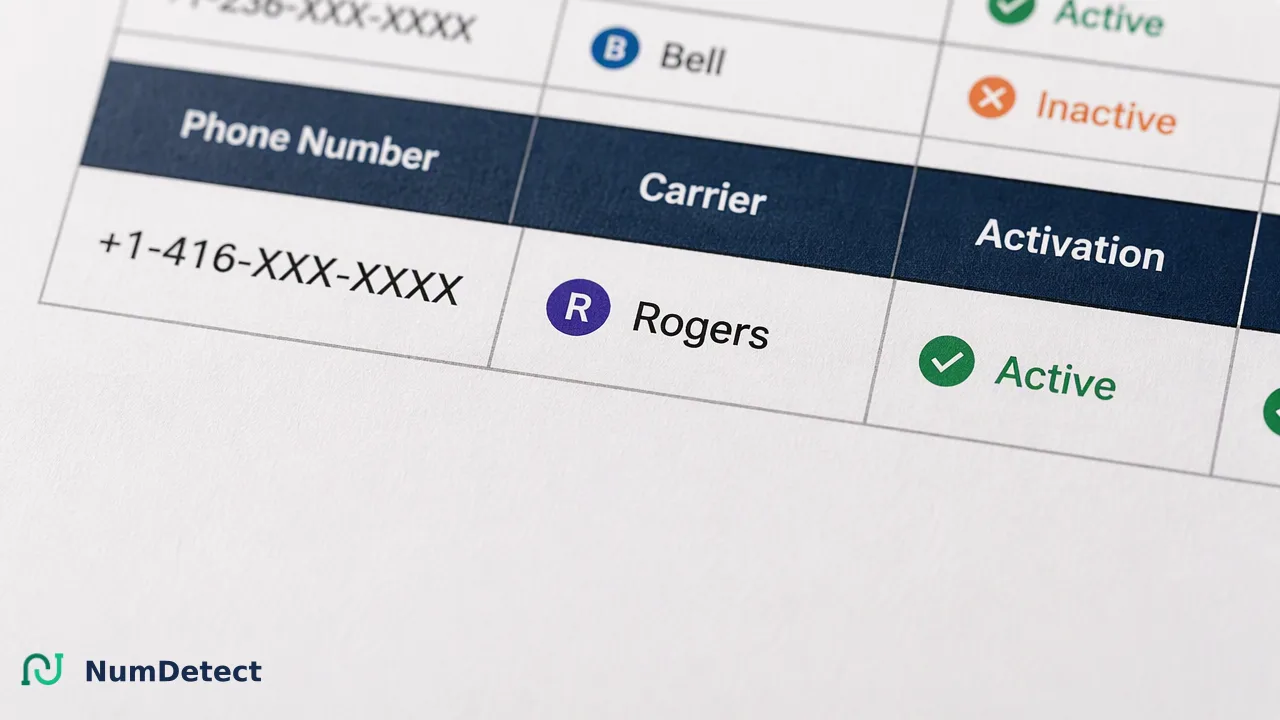
Learn why static prefix validation fails for Canadian phone numbers due to wireless number portability, and how asynchronous bulk carrier intelligence supports CRM data hygiene.
In Canada, static prefix-based validation is no longer reliable because widespread wireless number portability allows subscribers to retain their phone numbers when changing telecom providers. Canadian area codes denote geographic regions rather than specific mobile networks, meaning static prefix tables cannot accurately identify current serving carriers. To maintain reliable contact hygiene and routing context across large customer databases, technical teams must transition away from static tables and use asynchronous bulk carrier detection to review and segment phone records without assuming permanent carrier assignment or verified subscriber identity.
The Structure of Canadian Telephony and Shared Country Codes
Canadian phone numbers operate within the North American Numbering Plan, sharing the international country code +1 with the United States. This shared numbering plan means systems cannot rely solely on the country code to determine national routing rules or carrier infrastructure. Within Canada, three-digit area codes serve geographic boundaries rather than assigning blocks exclusively to single wireless or wireline carriers. Furthermore, standard phone numbers contain a national trunk prefix '1' when dialed domestically, which must be stripped to normalize the record into standard E.164 formatting (+1 followed by the 10-digit number). Relying on initial digits or area codes to infer the carrier network overlooks how numbering resources are distributed across regional markets.
Why Wireless Number Portability Invalidates Static Prefix Tables
Historically, telecommunications databases mapped three-digit central office codes (the exchange following the area code) to specific service providers. However, the regulatory adoption of Wireless Number Portability (WNP) has decoupled numbers from their original donor networks. Subscribers can easily move their mobile subscriptions across competitive carriers while retaining their existing numbers. Consequently, static databases and local lookup tables degrade rapidly as porting activity accumulates. Static prefix lookups cannot reflect recent carrier migrations, nor can they accurately differentiate between mobile, landline, and VOIP services once a number has moved between network types. Continuing to use prefix caches risks misinforming communication routing and operational analysis.
Modernizing Data Hygiene with Asynchronous Bulk Intelligence
To manage large Canadian contact lists without relying on outdated prefix tables, technical teams utilize asynchronous bulk phone-number intelligence platforms like NumDetect. Rather than querying numbers one by one, an asynchronous bulk workflow handles entire datasets in batch files to support data hygiene, regional analysis, and operational prioritization. Using dedicated carrier detection, teams can review phone-number records and append current network context across thousands of entries. This operational intelligence gives organizations the visibility needed to segment customer records and plan outreach workflows based on recent carrier attribution.
Workflow Execution for Bulk Contact Segmentation
When executing bulk list preparation, files are processed asynchronously through a standardized task pipeline. Organizations submit a file containing between 1,000 and 100,000 valid phone numbers formatted with one number per line in a TXT or CSV document, alongside an ISO country code. The process follows a straightforward API lifecycle:
- Submission: A task is initiated by making a request to
POST /api/v1/bulk-taskscontaining the prepared file and country parameters. 2. Status Tracking: The task lifecycle is monitored usingGET /api/v1/bulk-tasks/{id}, which reflects public states:processing,success, orfailed. 3. Data Application: Upon completion, the carrier signals are integrated into CRM workflows to inform list segmentation and regional outreach strategies.
Best Practices for Managing Canadian Number Records
Maintaining high-quality Canadian contact data requires combining syntactic standardization with periodic signal enrichment. Teams should apply systematic hygiene rules to keep operational systems organized:
| Process Step | Action | Operational Impact |
|---|---|---|
| Format Normalization | Strip domestic trunk prefix '1' and format to E.164 (+1NXXNXXXXXX) | Ensures consistent database storage and routing compatibility |
| Geographic Categorization | Map 3-digit area code to regional zones | Informs regional scheduling and timezone alignment |
| Carrier Detection | Run asynchronous bulk checks for current carrier context | Informs segmentation and record enrichment across customer databases |
| Activation Review | Review validation signals to flag inactive lines | Supports list hygiene and prioritization before campaign execution |
| Incorporating documented Phone Number Validation activation signals alongside carrier context helps teams review overall dataset health without assuming subscriber consent or ownership. |
FAQ
Why can't organizations rely on area codes to identify a carrier in Canada?
Canadian area codes denote geographic regions rather than telecommunication networks. Because mobile networks operate across shared regional area codes and subscribers can switch carriers via wireless number portability, a phone number's prefix provides no static guarantee of its current network.
How does wireless number portability impact CRM contact records?
Wireless number portability decouples initial assigned numbering ranges from the active carrier. Over time, stored prefix mappings become obsolete as subscribers migrate between mobile carriers, leading to inaccurate operational routing and flawed segmentation if contact data is not periodically reviewed.
What is the role of asynchronous bulk processing in Canadian number review?
Asynchronous bulk workflows allow teams to process large lists of 1,000 to 100,000 phone numbers via file tasks. This provides carrier context and activation signals across enterprise datasets to inform segmentation without requiring interactive single-number lookups.
Learn More
Choose the product information that fits the next step in your workflow.