
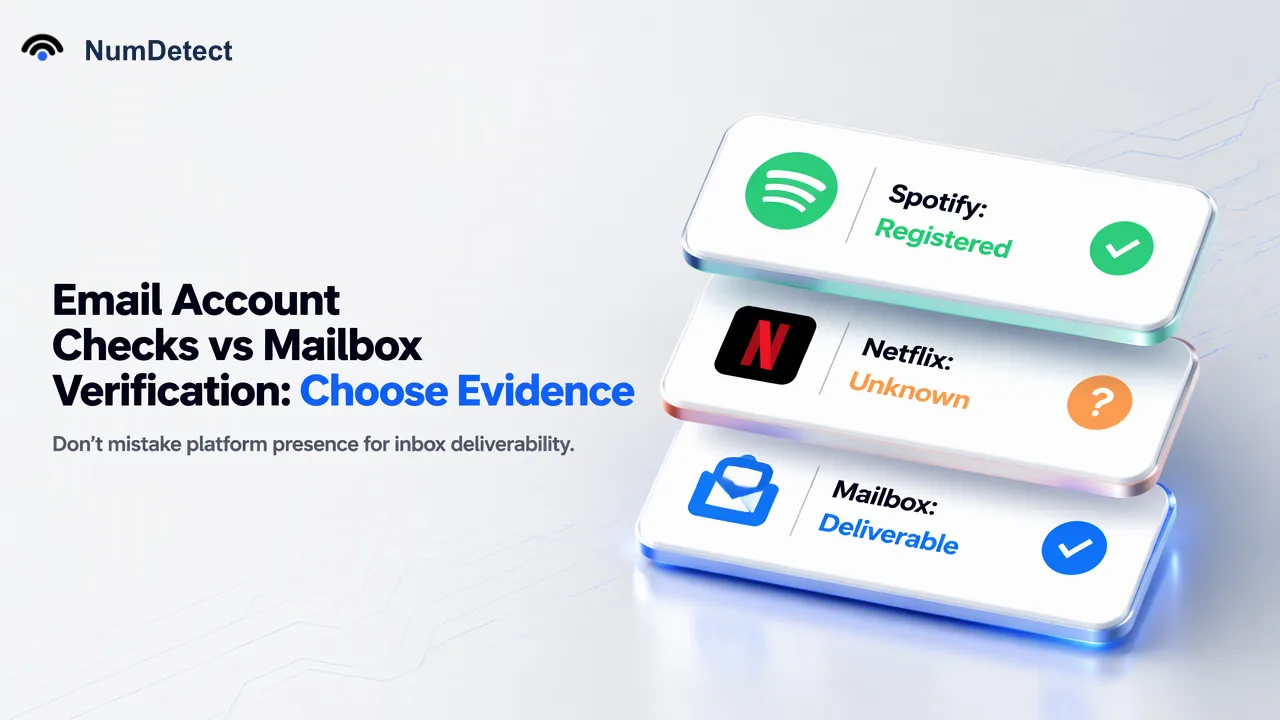
Compare platform account signals with mailbox checks, choose the right email workflow, and read conclusive, unknown and failed results correctly.
A platform account check and mailbox verification answer different questions about the same supplied address.
Use a platform account check when your question is whether a supplied email address shows a registration signal for a selected service, such as Spotify, Apple or Netflix. Use mailbox verification when your question concerns the address or its ability to receive mail. Neither answer proves who controls the inbox, whether a subscription is paid, or whether a message will be read. Choose the evidence you need before choosing the tool.
Start with the decision you need to make
An operations team may receive an email address from a contact and ask whether it is associated with a particular platform. Another team may want to clean a contact list before a permitted mailing. Those are different tasks, even though both start with the same string containing an @ sign. A platform registration signal is about one named service at the time of checking. A mailbox check is about the address or mail infrastructure. Treating either result as a general verdict on the person is an error.
| Question | Appropriate evidence | What the result cannot establish |
|---|---|---|
| Does this supplied address show a Spotify, Apple or Netflix registration signal? | A check for that selected platform | Inbox ownership, paid status or activity |
| Is the address formatted and associated with a mail domain that can accept mail? | A mailbox verification service with documented methods | Registration on a named platform or guaranteed delivery |
| Did this person authorize contact or read a message? | Your own consent and communication records | Neither type of checker supplies this answer |
The distinction matters because a “yes” for one product does not imply a “yes” for another. A “no” is limited to the selected product and the time of the check. An unknown result is not a negative result.
What a platform account check observes
NumDetect lists five email products: Apple, Facebook, Instagram, Netflix and Spotify. Its email account use case describes a platform-specific check rather than mailbox health. Begin with one supplied address and the product that matches the question. The public page also describes list uploads, but list processing and pricing are separate choices; a single check is enough to explain this decision. Phone and email products use different inputs and cannot be combined in one lookup.
Suppose a support analyst has an address supplied in a legitimate case and needs to understand whether it returns a Spotify account signal. The analyst selects Spotify for that address and records the product, time and returned status. A definite positive answer concerns Spotify account presence, not a subscription tier, a purchase, account ownership or recent use. A definite negative answer is scoped to the selected product and check time. An unknown status has no conclusive answer and should remain unknown in reports. This is a hypothetical workflow, not an observed case or a guarantee that any particular address returns a result.
The current Spotify email service page explicitly separates its account signal from SMTP deliverability and says the check sends no email. It also warns that the signal does not establish Premium subscription status or address ownership. Platform names identify selected checks; NumDetect is an independent service and has no implied platform endorsement.
What mailbox verification can answer instead
A mailbox verification service is the better fit when the task is to assess the address for an email workflow. Depending on that service’s documented method, it may inspect syntax, the domain and mail-routing records, or perform additional checks to estimate whether mail can be accepted. Ask the provider exactly which checks it runs, whether it sends mail, and how it handles temporary failures and catch-all domains. Do not assume every provider offers the same evidence or that a positive result guarantees inbox placement. Actual delivery also depends on the sending system, reputation and recipient-side filtering.
NumDetect does not offer SMTP mailbox verification or deliverability testing. Its email products do not send an email to establish control. If a team must confirm that the person controls the address, an appropriate consent or confirmation flow is needed. If it must decide whether to send a marketing message, the required permission and suppression records remain separate from either technical check. Account registration does not provide consent to contact someone.
Use the documented single-email route and read the status
The current NumDetect developers page describes the current single-check API. The Spotify email service page shows an illustrative email request for its Spotify product. Use an API key as an Authorization Bearer token on your server and send an Idempotency-Key when creating the check. The public example states that each run is a real, charged check. Inspect the current product catalogue and price before running one; a sample address in documentation does not turn a call into a free simulation.
Read each product’s status first. The public response explanation says success is conclusive and pairs with result: true or result: false. unknown has no conclusion; failed means that product could not be reached. When status is not success, result is null. Preserve those states in storage and reports. Do not coerce null to false, or merge answers across products into one identity score. The public response example uses a phone input, so it should not be treated as the complete email response schema; consult the current API reference for your implementation.
If a request response is lost, the developers page says to retry the same operation with the same idempotency key rather than creating another check with a new key. Keep the returned check ID and product-specific result with its check time. The signal can inform a limited workflow, but does not prove who owns the address or authorize contact and should not alone decide something with significant effects on a person.
Make the next check match your actual question
Write the question in one sentence before running anything: “Does this address show a registration signal for Spotify?” or “Can this address receive an email under our provider’s stated method?” For the first question, review the NumDetect email product list, choose the relevant product and keep the result scoped to that product, status and check time. For the second, evaluate a mailbox verification provider’s documented checks and limitations. If the question is ownership, consent, subscription or readership, design a separate source of evidence instead. This small decision step prevents a technically valid check from being used to answer the wrong question.
Learn More
Choose the product information that fits the next step in your workflow.
Sources
Prepared from NumDetect product documentation and the cited sources.