
Product guidance
Beyond Prefixes: Why Global Phone Number Validation Requires Portability Data
Discover why global phone number validation requires current portability data over static prefixes to improve data hygiene, list cleaning, and routing.
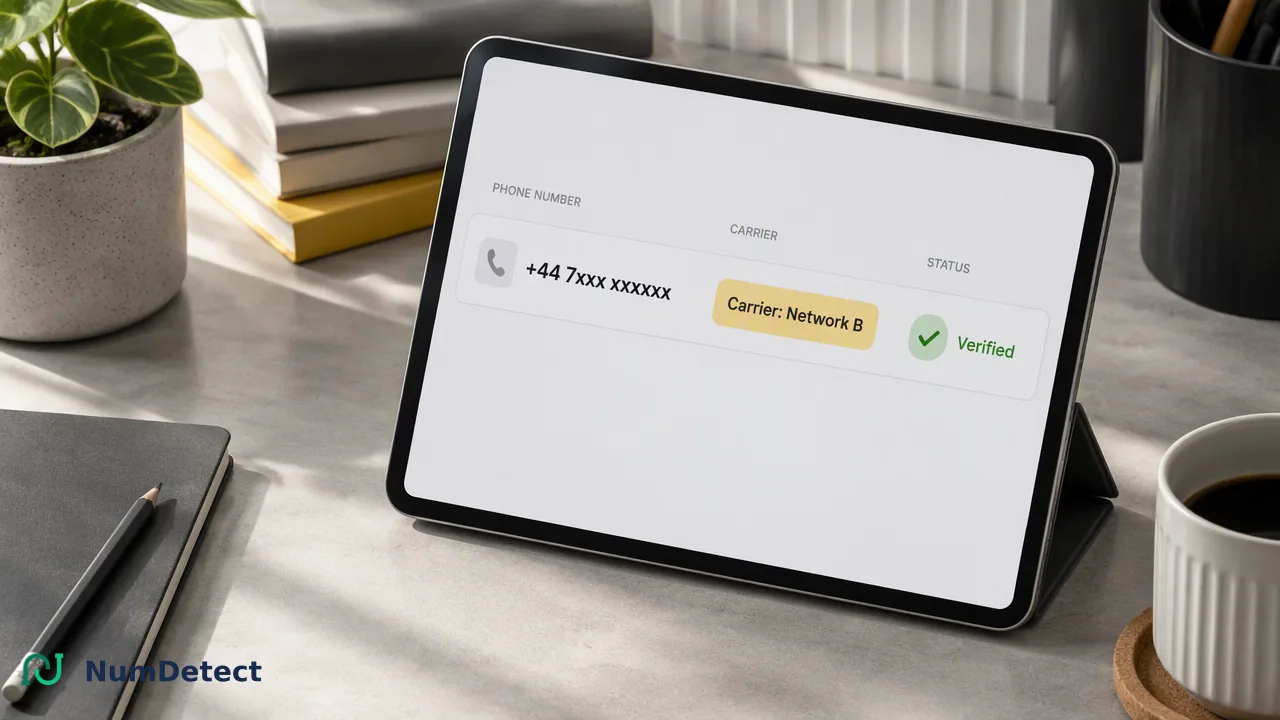
Relying on phone prefixes fails to reflect current carrier ownership due to global mobile number portability. Learn how dynamic carrier data and asynchronous bulk insights support accurate list cleaning, routing, and segmentation.
Global phone number validation requires current network portability data because static numbering prefixes reflect only the original carrier allocation, not current carrier ownership. Worldwide adoption of Mobile Number Portability (MNP) enables subscribers to retain numbers when transferring across operators, decoupling prefixes from serving networks. Consequently, static prefix tables create blind spots that degrade data hygiene and lead to misdirected routing. For organizations managing substantial contact databases, updating records via asynchronous bulk carrier detection provides current network context, supporting CRM enrichment, regional segmentation, and communication planning without relying on obsolete allocation assumptions.
The Limitation of Prefix-Based Allocation
National numbering plans historically assigned static blocks of digits to specific telecommunications providers. Under this legacy framework, the initial prefix—such as the national destination code and leading subscriber digits—indicated both the geographic region and the managing operator. However, regulatory frameworks worldwide introduced Mobile Number Portability (MNP) to foster market competition. MNP allows users to transfer service between competing carriers seamlessly while retaining their complete phone number. Because portability decouples the surface digits from the underlying operator, static prefix mapping no longer reflects operational reality. Relying exclusively on number formatting rules or original carrier allocation charts creates systematic blind spots in enterprise databases. An organization assuming that an allocated prefix represents the current serving carrier risks working with stale infrastructure assumptions, leading to inaccurate regional segmentation, misdirected internal categorization, and compromised reporting.
Operational Risks of Static Numbering Plans
Maintaining static numbering tables introduces compounding operational inefficiencies across enterprise workflows. When customer databases rely on obsolete carrier mappings, transmission costs frequently escalate. Telecommunications providers and aggregators calculate transit and termination rates based on the actual destination network. When outbound communications are dispatched under incorrect routing assumptions, intermediate network handoffs and carrier query surcharges drive up transmission expenses. Beyond cost fluctuations, unverified static records hinder list segmentation. Changes in numbering structures—such as the retirement of trunk codes, regional area code splits, or reassignment of numbering blocks—can render stored contacts unusable if records are not regularly validated against global E.164 standards and updated carrier context. Organizations depending on static data face elevated failure rates in message delivery and misinformed operational planning.
Modernizing Data Hygiene with Asynchronous Bulk Insights
To counteract data decay across large contact repositories, engineering and operations teams require a systematic approach to dataset enrichment. NumDetect provides an asynchronous bulk phone-number insight platform designed specifically for teams preparing high-volume lists for cleaning, segmentation, CRM enrichment, and operational prioritization. Rather than executing synchronous, one-by-one queries that stall internal pipelines, teams utilize asynchronous bulk workflows to process large files. Through the documented bulk-task workflow, users submit tasks containing between 500 and 500,000 valid phone numbers using a standard TXT or CSV file alongside an ISO country or region code (excluding China mainland numbers, which are not supported). Tasks are initiated via POST /api/v1/bulk-tasks and monitored through GET /api/v1/bulk-tasks/{id}, moving through documented public states of processing, success, or failed. This bulk approach appends current carrier context across entire customer bases without imposing synchronous architectural bottlenecks.
Optimizing Global Communication and Routing Strategies
Enriching enterprise records with accurate carrier context supports multiple downstream operational objectives. By identifying current network alignments, technical teams can evaluate routing tables, audit third-party messaging aggregators, and structure channel spending to reflect true operator distributions.
| Attribute | Prefix-Based Validation | Dynamic Carrier Context |
|---|---|---|
| Network Accuracy | Reflects original allocation only | Identifies current serving network |
| Portability Handling | Blind to transferred numbers | Tracks post-port network shifts |
| Line Classification | Inferred from static number ranges | Informs mobile, fixed-line, and VoIP classification |
| Workflow Suitability | Basic local format checking | Bulk data hygiene, CRM enrichment, routing review |
Distinguishing between mobile, fixed-line, and VoIP lines helps organizations segment customer touchpoints effectively, avoiding unnecessary SMS dispatches to fixed landlines. Carrier detection provides the necessary network context for record review, enabling teams to build clean, actionable datasets while maintaining clear boundaries regarding subscriber privacy.
FAQ
Why is prefix-based validation insufficient for modern contact lists?
Prefix-based checks reveal only the initial operator assignment established by regional numbering plans. Because mobile number portability is standard across global telecommunications markets, millions of subscribers transfer between networks while keeping their numbers intact. Evaluating a number solely by prefix creates outdated records, misidentifies the serving network, and introduces errors into downstream segmentation or transmission planning.
How does mobile number portability affect operational SMS routing?
When a subscriber switches networks, routing engines that rely on static prefix rules attempt to dispatch messages across the original network pathway. This mismatch forces intermediary carriers to perform dynamic dips, redirect traffic, or apply elevated inter-carrier termination fees. Utilizing updated carrier context helps organizations align messages with correct operational networks, supporting routing efficiency and budget control.
Learn More
Choose the product information that fits the next step in your workflow.