
Product guidance
Beyond Regex: Why Localized Phone Validation is Critical for Global Reach
Discover why localized phone number validation outperforms static regex for managing global contact lists, carrier routing, and CRM data hygiene.
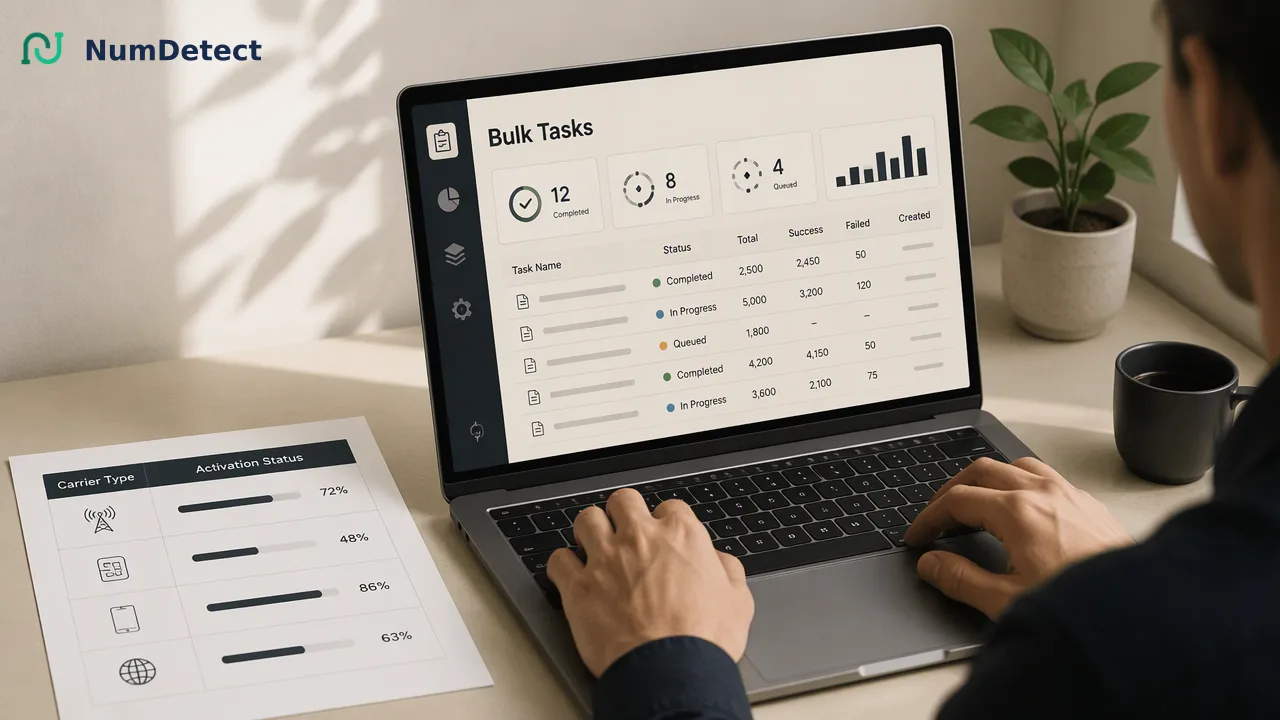
Static regex patterns cannot track carrier shifts, retired dialing codes, or network changes. Learn how dynamic carrier signals and asynchronous bulk insights support global data hygiene.
Localized phone number validation moves beyond static syntax rules to account for regional numbering plans, legacy format migrations, and network-level carrier assignments. While regular expressions only confirm whether a string matches a generic typographical pattern, they cannot verify whether a dialing code remains in service, whether a subscriber ported their number to another network, or whether an assigned line remains activated. Relying solely on static checks introduces corrupted records into communications infrastructure and operational databases. To maintain dependable contact directories, organizations combine localized formatting awareness with asynchronous bulk insights that deliver current carrier context and activation signals across international data repositories.
The Limitations of Static Validation
Engineering teams frequently implement regular expressions as a preliminary filter to verify user phone entries. While regex performs well for basic syntactic hygiene—such as enforcing character length, stripping punctuation, or confirming country codes—it operates in complete isolation from telecommunications networks. A pattern match confirms only that a sequence of digits resembles a plausible number, not that the number exists on a live exchange. Crucially, static validation cannot detect if a number is currently active or which carrier serves it today. Telecommunications regulatory bodies regularly update national numbering plans, assign new block prefixes, and deactivate obsolete sequences. Furthermore, the global adoption of mobile number portability means an original carrier prefix no longer guarantees the current network provider. When subscribers switch mobile carriers, their initial prefixes stay unchanged, rendering hardcoded lookup dictionaries obsolete. Teams that depend strictly on static pattern rules inevitably accumulate stale, unrouteable data within their enterprise systems.
Navigating Regional Complexity and Legacy Formats
Phone number formats and carrier allocations are dynamic and region-specific, making one-size-fits-all scripts fragile across borders. Telecommunications authorities frequently modify their dialing architecture to accommodate population growth, mobile service expansion, or technical standardization. When national authorities retire legacy trunk prefixes, databases that lack localized handling continue to record deprecated strings that fail downstream. For instance, historical prefix updates, such as the retirement of domestic long-distance and mobile prefixes like 044 and 045 in Mexico, illustrate how legacy dialing rules cause substantial data entry errors if databases fail to align with current national conventions. Without localized phone number validation that accounts for regional regulatory frameworks, applications store distorted dialing sequences that break routing pipelines. Managing international numbers demands ongoing awareness of regional formatting rules, line type classifications, and national numbering plan revisions.
The Role of Asynchronous Bulk Insights
Managing enterprise databases requires moving past isolated syntax tests toward structured data enrichment pipelines. NumDetect is an asynchronous bulk phone-number insight platform for teams and developers preparing large number lists for cleaning, segmentation, CRM enrichment, regional analysis, and operational prioritization. Instead of processing entries via blocking single-number requests, teams structure large datasets into regional input files. Through an asynchronous workflow, users submit batches ranging from 500 to 500,000 numbers in TXT or CSV format alongside a designated ISO country or region code using POST /api/v1/bulk-tasks. The platform processes the file in the background, allowing systems to retrieve status updates—transitioning through processing, success, or failed states—via GET /api/v1/bulk-tasks/{id}. NumDetect provides activation signals and carrier context to support phone-list review and CRM hygiene. These asynchronous signals give teams systematic visibility into list quality without the latency bottlenecks of synchronous network calls.
Optimizing Data Hygiene for Global Operations
Accurate telecommunications insights directly inform operational segmentation and infrastructure routing. Distinguishing between mobile and fixed-line numbers is essential for routing SMS and voice traffic effectively. Sending text messages to landline allocations wastes transmission budgets and skews performance metrics, while attempting automated voice broadcasts over unsupported ranges disrupts customer operations. Bulk insights help technical and operations teams focus limited resources on reachable records. Incorporating carrier context and activation signals supports internal list-cleaning routines and informs routing policies before launches. However, teams must apply these signals according to their documented scope. When paired with responsible governance, dynamic bulk validation protects data integrity across international repositories.
FAQ
Why is regex insufficient for global phone number validation?
Regular expressions only inspect character structure against a static syntax rule. They cannot determine if an area code was retired, if an exchange allocation changed, or whether a subscriber line is currently activated. Because regex evaluates text without querying carrier allocations or current network databases, syntactically flawless numbers can still represent inactive lines, invalid legacy arrangements, or disconnected routes across international telecommunications environments.
How does number portability affect carrier detection?
Mobile number portability permits subscribers to transfer their existing numbers to competing network operators while retaining their original dialing prefixes. As a consequence, historical prefix tables and rule-based parsing logic no longer identify the current network provider. Determining the serving carrier requires dynamic carrier detection signals rather than static prefix lookup tables to support accurate routing evaluations.
What is the role of an asynchronous bulk workflow in managing phone datasets?
Asynchronous bulk workflows allow teams to submit large files containing 500 to 500,000 numbers for regional analysis and CRM hygiene without maintaining long-running synchronous connections. Platforms like NumDetect accept structured files per region, execute network insight tasks in the background, and provide activation and carrier signals that inform downstream segmentation, cleaning, and outreach prioritization.
Learn More
Choose the product information that fits the next step in your workflow.