
Product guidance
How to Clean Your Phone Number Database for Better SMS ROI
Learn how phone number list hygiene supports SMS ROI. Discover how an asynchronous bulk file-task workflow helps teams optimize routing and reduce spend.
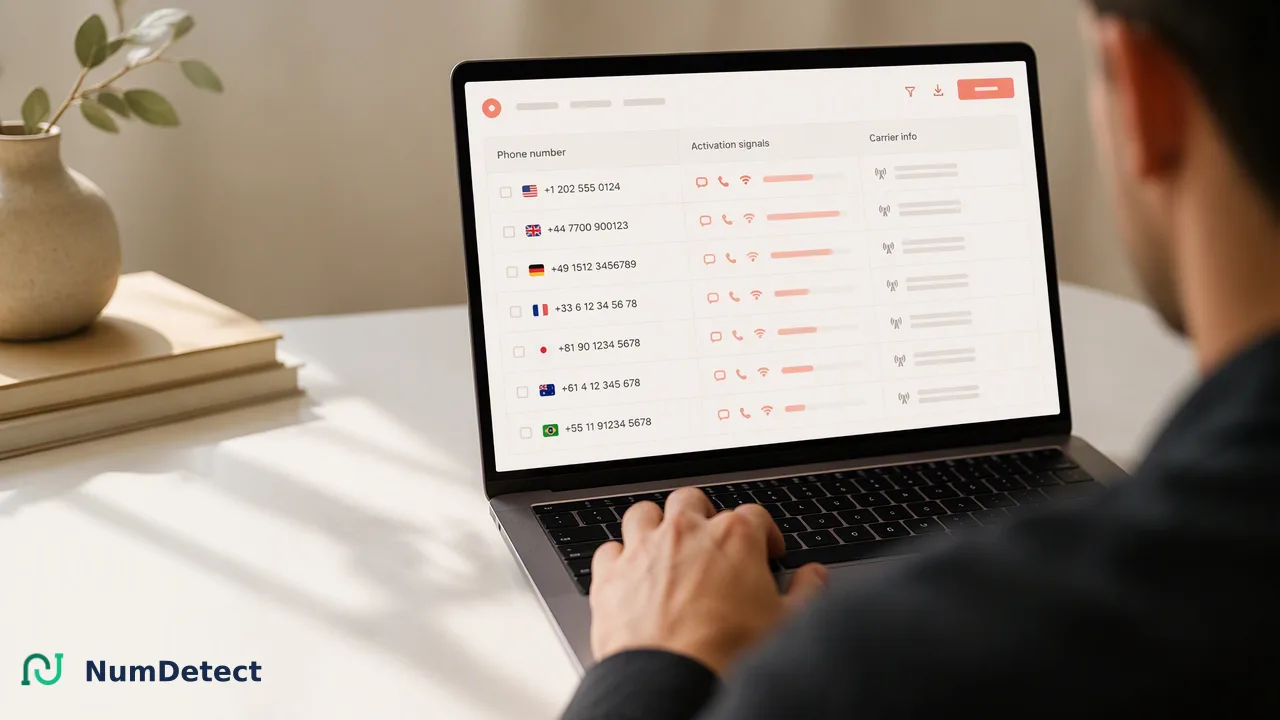
Learn how phone number list hygiene supports SMS ROI. Discover how an asynchronous bulk file-task workflow helps teams optimize routing, segment audiences, and reduce wasted spend.
Phone number list hygiene is a critical operational step that supports better SMS ROI by identifying active records and filtering out inactive entries before campaigns launch. High-volume messaging requires accurate contact data to optimize routing and reduce wasted spend on unreachable destinations. By utilizing an asynchronous bulk phone-number insight platform, organizations can process large databases efficiently. This workflow moves beyond basic formatting by returning specific activation, carrier, and activity signals that inform internal decisions. Cleaning a database ensures that teams focus their resources on relevant audience segments, supporting overall data-quality review and operational prioritization without relying on real-time single-number lookups.
The Impact of List Hygiene on SMS Campaigns
Maintaining accurate contact data is essential for organizations managing high-volume messaging. Over time, CRM systems accumulate stale or inactive records, which can drain campaign budgets if left unchecked. Phone number list hygiene helps teams review these databases, identifying which records are worth prioritizing and which may require suppression. Cleaning a phone number list before a campaign prevents wasted spend on invalid numbers and supports overall operational efficiency. When teams deploy messages to unverified lists, they risk routing resources to inactive destinations. Implementing a structured hygiene process provides valuable context for audience segmentation and regional analysis. By utilizing bulk phone-number insights, organizations can systematically evaluate large datasets, ensuring that outreach efforts are informed by current network and activity signals. This proactive approach to data management contributes to better resource allocation, helping teams optimize their SMS ROI while maintaining a clean, actionable CRM environment.
Phone Number Validation and Activation Signals
Preparing a database for outreach often begins with standardizing records to the E.164 format, an international standard that ensures consistency across global databases. However, formatting alone does not provide insight into a number's current status. Phone Number Validation addresses this by returning a documented activation signal to support phone-list review and CRM hygiene. This activation signal helps teams identify records that are viable candidates for outreach. Instead, it serves as a decision-support tool that informs internal routing and prioritization. By integrating Phone Number Validation into an asynchronous bulk workflow, developers and operational teams can efficiently process large lists, separating active signals from inactive ones to support more targeted and cost-effective campaign planning.
Optimizing Routing with Global Carrier Detection
Understanding the network context of a contact list is a vital component of phone number list hygiene. Global Carrier Detection returns carrier information for phone-number records, providing routing-ready context that supports regional analysis and segmentation. This capability accounts for number portability and source variation, ensuring that teams have accurate network data even when subscribers switch providers. Identifying the specific carrier associated with a number helps organizations optimize their messaging costs and routing paths. By incorporating Global Carrier Detection into bulk processing tasks, teams can segment their audiences based on network characteristics. This segmentation informs internal decisions regarding which routing providers to use for specific campaigns, ultimately contributing to a more efficient and cost-effective messaging infrastructure.
Utilizing Number Activity and Audience Signals
Beyond basic validation and carrier detection, organizations can leverage specific activity signals to further refine their databases. The Number Activity capability returns an activity signal to support prioritization and segmentation without reporting specific activity time or frequency. This allows teams to rank records based on general network presence rather than tracking individual user behavior. Additionally, the E-commerce Active capability returns an e-commerce activity signal for audience review and campaign planning. Similarly, the High-Value Users capability provides a potential high-value signal based on premium-device characteristics and recent network activity. By evaluating these distinct signals through an asynchronous bulk workflow, teams can build highly segmented lists that support targeted campaign strategies.
Operationalizing the Asynchronous Bulk Workflow
NumDetect provides an asynchronous bulk phone-number insight platform designed for teams and developers preparing large number lists. This system operates strictly as an asynchronous file-task workflow, not a real-time single-number lookup tool. To initiate a hygiene process, developers use the POST /api/v1/bulk-tasks endpoint to submit a task. Each task requires a TXT or CSV file containing one number per line, with a total of 1,000 to 100,000 valid numbers, and must specify one ISO country or region code. Note that China mainland numbers are not supported by this bulk phone-number task workflow. Once a task is submitted, teams can retrieve its status using the GET /api/v1/bulk-tasks/{id} endpoint. The public states for these tasks are processing, success, and failed. This asynchronous architecture allows organizations to process massive datasets efficiently in the background, enriching CRM records with validation, carrier, and activity signals without maintaining persistent open connections.
FAQ
Why is phone number list hygiene important for SMS campaigns?
Phone number list hygiene helps organizations review their databases to identify active records and filter out inactive entries. Cleaning a phone number list before a campaign prevents wasted spend on invalid numbers and supports better resource allocation. By utilizing bulk phone-number insights, teams can optimize routing, improve regional analysis, and ensure that high-volume messaging efforts are focused on relevant audience segments.
How does phone number validation support CRM review?
Phone Number Validation returns a documented activation signal to support phone-list review and CRM hygiene. This signal helps teams identify which records are viable candidates for outreach.
How does an asynchronous bulk workflow process large databases?
An asynchronous bulk workflow allows teams to submit large files for background processing rather than performing real-time single-number lookups. Developers submit a TXT or CSV file containing 1,000 to 100,000 numbers via the POST /api/v1/bulk-tasks endpoint. The system processes the file asynchronously, and teams can check the status—processing, success, or failed—using the GET /api/v1/bulk-tasks/{id} endpoint to retrieve the enriched data.
What role does carrier detection play in list segmentation?
Global Carrier Detection returns carrier information for phone-number records, accounting for number portability and source variation. This network context supports regional analysis and helps teams optimize routing paths for high-volume messaging.
How do activity signals inform operational prioritization?
The Number Activity capability returns an activity signal to support prioritization and segmentation without reporting specific activity time or frequency. Alongside signals like E-commerce Active and High-Value Users, these insights help teams rank records for campaign planning.