
Product guidance
Why Prefix-Based Phone Validation Fails: The Reality of Number Portability
Prefix-based phone validation fails due to number portability. Learn why static prefix lookups degrade and how bulk carrier detection updates routing context.
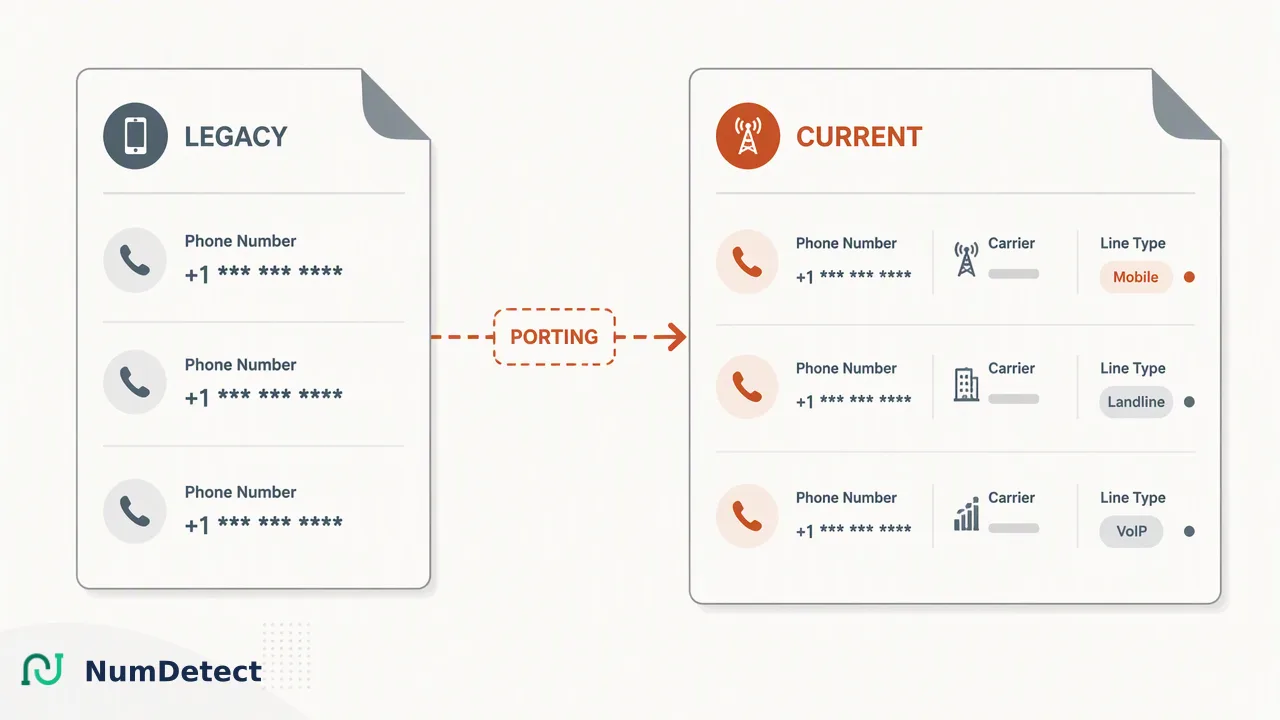
Prefix-based phone validation fails because Mobile Number Portability allows users to switch carriers without changing numbers. Accurate routing requires dynamic carrier detection.
Prefix-based phone validation fails because it relies on static numbering allocations that do not reflect Mobile Number Portability (MNP). When a subscriber switches network providers, their phone number remains identical while the underlying serving carrier changes. Consequently, checking initial prefixes or regular expressions can confirm basic formatting, but it cannot identify the active network service or line type. For organizations managing communication workflows, operations, or CRM data hygiene, dynamic phone number portability lookup through asynchronous bulk carrier detection provides current network context rather than obsolete static assumptions.
The Fallacy of Static Numbering Plans
Decades ago, telecommunications regulators assigned telephone number blocks in rigid, geographical, or network-defined ranges. A specific national area code and local prefix belonged exclusively to a single wireline utility or national mobile operator. Under that architecture, determining network ownership required little more than reading the initial digits of a given subscriber string. Mobile Number Portability dismantled that model. Regulators worldwide introduced MNP to encourage market competition, granting subscribers the legal right to retain their directory numbers when migrating to another carrier. A static prefix lookup merely queries an archive of original assignments. Relying on these historical allocations leads teams to assume an operator identity that may have changed years prior, undermining the baseline assumptions of data systems and customer databases.
How Number Portability Impacts Customer Data
Every ported record creates a divergence between the original carrier allocation and the current network service. When a user transfers from Carrier A to Carrier B, legacy local databases continue attributing the line to Carrier A based on numerical prefixes. Over time, as consumer churn and market promotions prompt subscribers to migrate, unrefreshed contact databases experience compounding data decay.
| Validation Approach | Primary Mechanism | Data Yielded | Portability Awareness |
|---|---|---|---|
| Prefix Mapping | Static lookup table | Original block owner | No (assumes fixed assignment) |
| Syntax Matching (Regex) | String parsing | Format conformity | No (evaluates pattern only) |
| Dynamic Carrier Detection | Asynchronous network query | Serving network signal | Yes (reflects ported carrier) |
This gap directly impacts operations. Message aggregators and enterprise dispatch systems rely on accurate routing context to select proper gateways. Misidentifying the serving network can degrade routing pipelines and inflate operational transmission overhead.
The Limitations of Regex and Pattern Matching
Regular expressions (regex) remain a common tool in software development for pre-filtering user input. They excel at validating character counts, matching country codes, and confirming adherence to formatting standards such as E.164. However, pattern matching stops at the structural boundary. A regex pattern cannot inspect network registry states. It cannot confirm whether a number has been migrated, whether it operates on a mobile network, or if it has been reassigned to a fixed landline or Voice-over-IP (VoIP) provider. Because VoIP providers frequently utilize blocks historically assigned to wireline or wireless carriers, structural string matching fails to separate interactive mobile subscribers from non-SMS-capable virtual lines. Global phone number portability lookup requires querying dynamic network indicators to establish functional routing context.
Modernizing Data Hygiene with Asynchronous Bulk Detection
Maintaining current network records across large contact volumes requires moving beyond static lookup tables toward scalable data enrichment workflows. Rather than querying numbers one by one during interactive sessions, enterprise systems processing historical directories, CRM migrations, or operational lead queues benefit from asynchronous bulk processing. Platforms such as NumDetect provide Global Carrier Detection specifically engineered for large datasets. Teams submit files containing 500 to 500,000 valid phone records along with an ISO country or region code (excluding China mainland, which is not supported). The asynchronous task processes the batch and appends carrier context alongside line-type details. This dataset serves as an analytical signal for internal operational prioritization, segmentation, and gateway routing, supporting data hygiene without relying on static prefix assumptions.
FAQ
Why is prefix-based carrier identification no longer accurate?
Prefix-based identification assumes fixed blocks of numbers belong permanently to their original issuing carrier. With the global implementation of Mobile Number Portability, subscribers frequently switch network operators while retaining their existing numbers. As a result, initial prefix digits identify only the original allocation, not the provider currently serving the record.
How does Mobile Number Portability affect SMS routing?
Mobile Number Portability decouples the telephone number from the initial network provider. If an organization routes messages based on static prefix tables, messages may be directed to the wrong network gateway, leading to routing inefficiencies, miscalculated interconnect costs, or failed message transmissions across non-supported carrier interfaces.
What is the difference between standard format validation and carrier lookup?
Standard format validation, often performed using regular expressions, checks whether a telephone string adheres to numerical length and structure rules. Carrier lookup identifies the specific network operator associated with the record, distinguishing between original block assignments and the active carrier network providing service.
How can teams handle carrier detection for large phone number lists?
Teams handling large datasets can utilize asynchronous bulk processing platforms like NumDetect. Submitting structured lists of 500 to 500,000 numbers allows organizations to append updated carrier context and line-type indicators across records without maintaining complex static prefix databases.
Learn More
Choose the product information that fits the next step in your workflow.