
Product guidance
Phone Number Verification Best Practices: Beyond Client-Side Validation
Explore phone number verification best practices. Learn why client-side checks fail and how asynchronous bulk intelligence enriches database records.
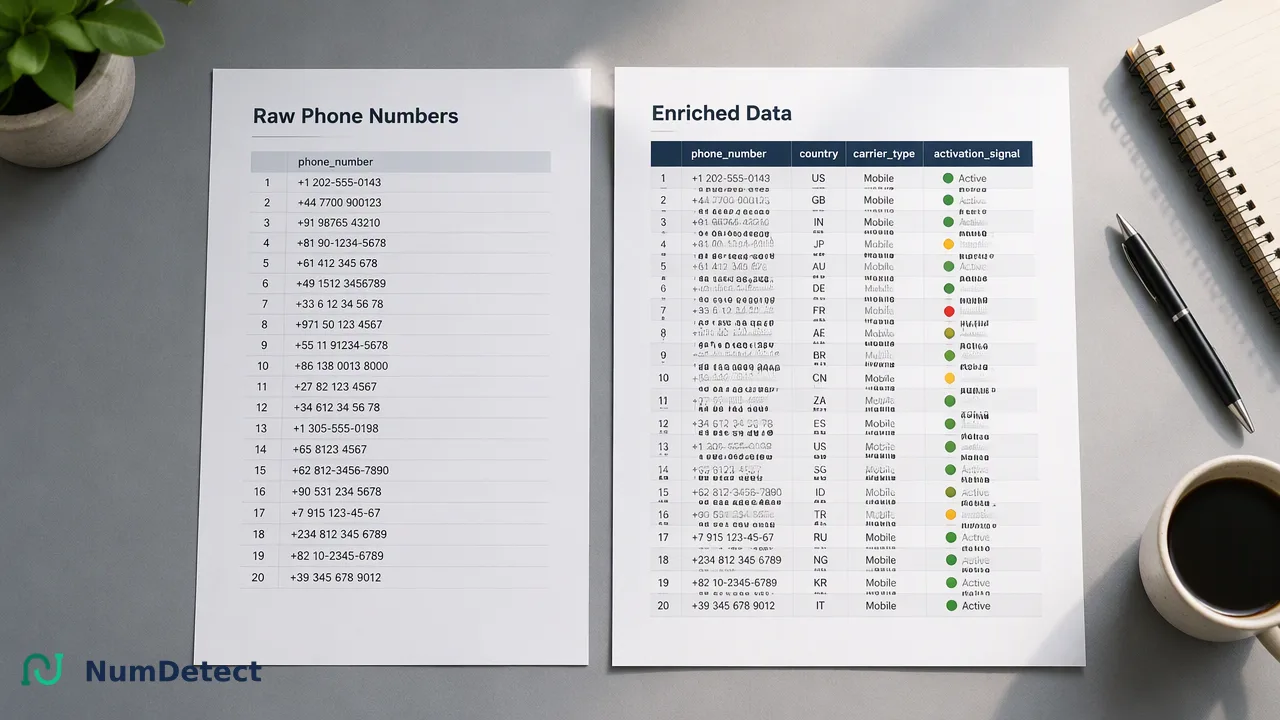
Learn phone number verification best practices to move beyond client-side regex checks using asynchronous bulk phone intelligence, carrier context, and standardized E.164 formatting.
Client-side phone number validation relies primarily on regular expressions and browser constraints to confirm that an input string conforms to expected numbering structures. While structural formatting checks catch typographical errors at the point of data entry, they cannot confirm whether an entry corresponds to a functional line, an assigned carrier, or an active subscriber. Production-grade phone number verification best practices require pairing initial format standardization with server-side intelligence. By processing customer records through asynchronous bulk verification workflows, engineering and data operations teams identify active lines, append operational carrier details, and maintain high database quality across large customer lists.
The Limits of Client-Side Validation
Client-side validation provides immediate visual feedback in web forms and mobile interfaces. By matching user input against predefined regular expressions, front-end scripts help users catch missing digits, extraneous punctuation, or unsupported area codes before submitting a form.
Client-side constraint validation operates exclusively on string geometry. A browser script cannot determine whether a telecommunications provider has allocated a specific numerical block or assigned a particular number to an active subscriber. Fictitious sequences such as +1 (555) 019-9283 satisfy typical North American format rules while failing to connect to any operational terminal. Relying solely on browser-level validation creates a false sense of data integrity, allowing inactive, disconnected, and unassigned entries to flow unimpeded into core databases and enterprise CRM systems.
Structural Validation vs. Functional Verification
Implementing robust data hygiene requires understanding the operational distinction between structural validation and functional phone verification.
| Verification Stage | Operational Scope | Primary Evaluation Criteria |
|---|---|---|
| Structural Validation | Syntactic parsing | Checks character sets, digit counts, and format schemas like E.164 |
| Functional Verification | Server-side intelligence | Evaluates activation status, carrier assignment, and network presence |
Structural checks confirm that a phone number adheres to international conventions defined by ITU-T Recommendation E.164, which limits international public telecommunication numbers to 15 digits starting with an assigned country code. Functional verification examines network-level attributes to confirm whether the number is operational. Phone Number Validation services return an activation signal to inform list review and database cleaning workflows. Combining structural formatting with functional verification establishes a disciplined defense against decaying contact databases.
Operationalizing Phone Intelligence at Scale
Synchronous single-record lookups introduce latency that can stall high-throughput ingestion pipelines and large data migration tasks. Modern data architectures address this operational bottleneck through asynchronous bulk processing workflows.
NumDetect functions as an asynchronous bulk phone-number insight platform for teams and developers preparing large number lists for cleaning, segmentation, CRM enrichment, regional analysis, and operational prioritization. Instead of evaluating individual numbers sequentially, teams submit contact files to standardized endpoints:
- Task Creation: Engineers submit batch files through
POST /api/v1/bulk-tasks, supplying plain TXT or CSV files containing one number per line along with the corresponding ISO country or region code. - Status Ingestion: Workflows poll
GET /api/v1/bulk-tasks/{id}to observe progress across documented states, including processing, success, and failed. - Batch Segmentation: Once tasks succeed, systems consume returned signals to segment active contacts from unallocated records without burdening front-end application threads.
Enriching Records with Carrier Context and Regional Intelligence
Beyond basic activation signals, production systems benefit from appending carrier and geographical context to phone records. Telecommunications landscapes remain fluid; in the United States, consumers frequently change service providers while retaining their numbers through mobile and wireline porting, as documented in regulatory guidance from Porting: Keeping Your Phone Number When You Change Providers.
Global carrier lookup returns carrier context for phone-number records in an asynchronous bulk workflow. By mapping numbers to their operating networks, engineering teams optimize downstream routing strategies, categorize lines by network operator, and perform regional market analyses. Furthermore, maintaining accurate, verified records aligns with data hygiene requirements under international standards such as GDPR Article 5 (Regulation (EU) 2016/679), which emphasizes data minimisation and maintaining accurate personal data for operational purposes.
FAQ
Why is regex validation insufficient for production databases?
Regular expressions evaluate only surface syntax, checking whether an entered string matches numerical length and digit patterns. A mathematically valid string can still represent an unallocated exchange, a disconnected route, or an inactive line. Relying solely on client-side regex allows non-functional numbers into downstream applications. Integrating server-side phone number validation checks whether a number corresponds to an activated network record before routing customer communications.
How does asynchronous bulk processing support data operations?
Asynchronous bulk processing handles high-volume datasets efficiently without subjecting applications to synchronous request latency. Engineering teams upload line-delimited files, letting background pipelines perform batch carrier lookups and activation evaluations. This architecture allows organizations to audit customer databases, prepare marketing campaigns, and update CRM records systematically. Teams track task progression across documented states until processed outputs are ready for automated ingestion.
How should teams standardize international phone records before verification?
Teams should canonicalize contact numbers into the international standard established by ITU-T Recommendation E.164. Under this framework, complete phone records include a country code followed by national destination codes and subscriber numbers, totaling at most 15 digits. Normalizing numbers into this format eliminates ambiguous local prefixes, supports cross-border routing consistency, and ensures clean inputs for automated bulk intelligence pipelines.
Learn More
Choose the product information that fits the next step in your workflow.