
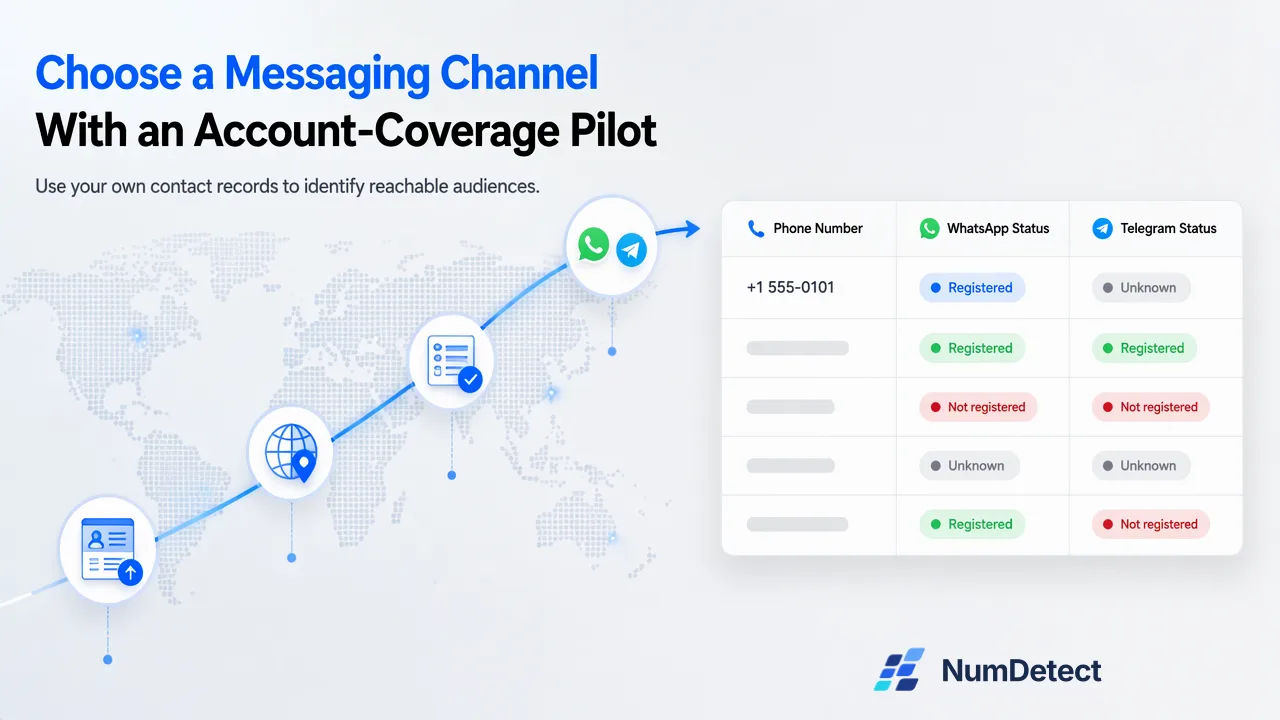
Compare WhatsApp, Telegram, Viber and Zalo account signals on an eligible contact sample, then test the channel people prefer.
A team can choose a messaging pilot from its own eligible list by comparing supported account signals, then checking preference, permission and real response.
To choose a messaging-channel pilot, take an eligible sample from the contact list you already have, run the relevant platform registration checks, count yes, no, unknown and unsupported separately, and then compare the result with customer preference and permission. Account coverage is a planning signal, not a promise of delivery or response.
Begin with the audience you can actually contact
A market popularity chart can suggest where to look, but it cannot tell a business which of its own customers have accounts on a particular platform. A seller deciding between WhatsApp, Telegram, Viber and Zalo should begin with the contact records it is allowed to use for the intended communication. The business question is concrete: which one channel deserves a limited, measurable pilot with this audience?
Choose a representative set of existing phone records rather than only the newest or most responsive customers. Keep a source-record ID, region, customer segment and permission status with each row. Normalize phone numbers without erasing the original value. If the list spans countries, record the country context needed for the chosen products. A bad sample can make a technically correct check answer the wrong business question.
NumDetect’s product catalogue includes phone-based WhatsApp, Telegram, Viber and Zalo account checks. Choose products that match the identifiers already held; do not mix email checks into a phone-only cohort or assume every product has identical country support. The channel-selection use case gives the business setting, while the current API documentation defines the actual request workflow.
Keep each platform result and each source row separate
Run the selected checks for the same eligible cohort and retain the original row key. A number can have a yes signal on more than one platform. Do not add platform yes counts and call the sum “people reachable”: that would count the same phone record more than once. Keep one column per platform and a check date so the team can see overlap and later changes.
For each product, report the denominator first: how many source records were eligible, how many were submitted, and how many produced a usable platform result. Then count yes, no, unknown and unsupported separately. A no result for one platform does not make the number invalid, and an unknown result is not a no. Unsupported entries should not be hidden inside a low-coverage percentage. A simple comparison can show, for example, “of the eligible submitted records, this many had a yes observation; this many were unresolved.” Use the actual run’s counts, not an illustrative percentage presented as a customer result.
NumDetect checks account-registration signals; it does not send a campaign or measure replies. General channel guides discuss audience, message type and consent (Rocketly), but the team’s own row-level test supplies the missing account-coverage evidence. The two inputs are complementary, not interchangeable.
Turn coverage into one limited channel experiment
A high yes count is a reason to consider a channel, not a reason to send immediately. Ask which channel customers have chosen for this type of message, what permission the business holds, and whether the message fits that channel. A smaller channel may be the right first pilot if customers explicitly prefer it and the use case is narrow. The decision should name a segment and message purpose, not “all contacts.”
Record a simple pilot decision: the chosen channel, eligible cohort, permission rule, intended message, responsible owner and result to observe. Use the organization’s own authorized sending process and measure actual delivery and customer response there. Those outcomes are separate from the account check. If the experiment fails, distinguish low account coverage from poor content, a sending issue or a mismatch with customer preference before changing the next test. Write down the pilot result beside the earlier account-coverage report. The two observations should have different dates and denominators: one describes the checked list, and the other describes the small group that was actually eligible and contacted. This prevents a team from presenting a registration percentage as an achieved campaign outcome.
For the next channel choice, take an eligible sample, compare the supported product signals with honest denominators, and choose one small authorized pilot. This is more useful than treating regional platform popularity as a substitute for what your own list and customers reveal.
Learn More
Choose the product information that fits the next step in your workflow.
Sources
Prepared from NumDetect product documentation and the cited sources.