
Product guidance
Architecting Compliant AI Voice Agents: A Guide to Identity and Data Sovereignty
Learn how to architect compliant AI voice agents with pre-call intelligence, transparent audit logging, human handovers, and strict data sovereignty.
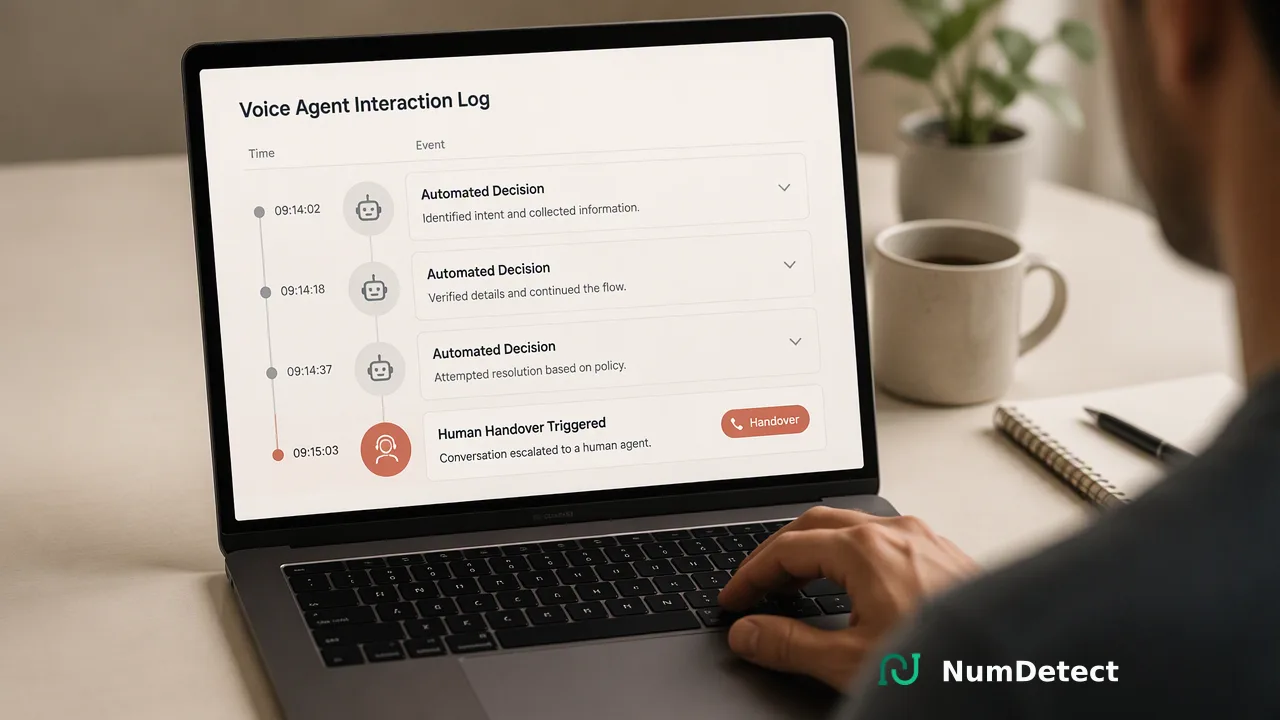
Deploying compliant AI voice agents requires clear data sovereignty, automated decision logging, transparent handovers, and rigorous pre-call data hygiene.
Architecting compliant AI voice agents requires aligning operational workflows with regional governance, end-to-end auditability, and disciplined data hygiene. In modern contact centers, ai voice agent identity verification relies on multi-layered verification signals rather than single assumptions. By implementing pre-call asynchronous bulk phone-number intelligence alongside structured automated decision logging, organizations can prepare and clean contact lists before launching outreach. This pre-interaction hygiene supports regulatory compliance by minimizing unnecessary data handling, confirming telecommunication context, and ensuring automated voice systems operate transparently within established jurisdictional boundaries and strict data sovereignty frameworks.
The Compliance Imperative in AI Voice Orchestration
Selecting AI contact center solutions requires prioritizing transparency, data sovereignty, and auditability to meet evolving regulatory standards for automated decision-making. Modern voice orchestration has moved past simple call deflection metrics, where success was judged primarily by containment volume.
Today, contact center performance centers on quality-based resolution rates that reflect accurate, compliant customer outcomes. Regulated industries face scrutiny over how automated voice agents handle personal records, authenticate callers, and make real-time decisions. When automated systems make unauthorized decisions or misroute sensitive inquiries, organizations face severe compliance exposure. Prioritizing auditability from the initial architectural phase helps teams document every step of the voice interaction lifecycle, demonstrating that operational rules and ethical safeguards govern every automated call.
Prioritizing Data Sovereignty and Residency
Data sovereignty represents the principle that digital information remains subject to the laws and governance frameworks of the country where it is collected or processed. When deploying global AI voice systems, managing data residency is critical for selecting underlying telephony, model hosting, and verification services.
International frameworks impose strict boundaries on cross-border data transfers. For example, under GDPR Article 5 (Regulation (EU) 2016/679), personal data must be adequate, relevant, and limited to what is necessary for the purposes for which it is processed. Voice architectures that process caller audio, transcripts, and metadata across foreign jurisdictions without regional safeguards risk substantial legal penalties. Establishing clear data residency boundaries ensures that AI processing, voice synthesis, and insight pipelines respect local telecommunications regulations and privacy mandates.
Strengthening AI Accuracy with Pre-Call Intelligence
Operational hygiene prior to call initiation supports compliance and protects call center reputation. NumDetect is an asynchronous bulk phone-number insight platform for teams and developers preparing large number lists for cleaning, segmentation, CRM enrichment, regional analysis, and operational prioritization.
Rather than executing real-time lookups during a live dial, teams can submit bulk file tasks (using TXT or CSV formats with one number per line) to evaluate list quality asynchronously. Global carrier lookup returns carrier context for phone-number records in an asynchronous bulk workflow, helping systems determine regional telecommunication parameters. Pre-call data preparation helps teams filter inactive lines, segment routing queues, and apply jurisdiction-specific calling rules, supporting compliance without introducing latency into runtime voice models. Note that mainland China numbers are not supported in this bulk workflow.
Designing for Auditability and Human Handover
Compliance in automated voice systems depends on complete visibility into automated decisions. Automated decision logging is essential for auditability, recording exactly why an agent selected a specific dialogue branch, requested step-up authentication, or flagged an interaction for review.
Equally important is the design of transparent handovers between AI agents and human operators. When a voice agent encounters ambiguous customer intent, potential identity fraud signals, or customer frustration, it must transfer the session cleanly without dropping conversational context. Logging the complete interaction history—including pre-call routing signals and in-call decision checkpoints—gives human agents the necessary background to resolve complex inquiries while producing an immutable audit trail for internal compliance reviews.
Managing Vendor Risk Through Substitutable Components
Relying on tightly coupled, monolithic contact center platforms creates significant vendor risk. If a single provider changes its data governance terms, experiences downtime, or fails to meet local data sovereignty standards, the entire voice operation faces disruption.
Architecting voice stacks with modular, substitutable components allows organizations to decouple large language models, telephony carriers, speech recognition engines, and data intelligence services. For example, using specialized tools for bulk list cleaning separate from core conversational execution lets teams swap underlying AI models or telecom providers as regulatory requirements evolve. This architectural flexibility mitigates long-term vendor lock-in, reinforces governance controls, and ensures uninterrupted operational resilience across changing global regulatory landscapes.
FAQ
How does bulk phone-number intelligence support AI compliance?
Bulk phone-number intelligence helps teams clean outreach lists before automated voice systems engage contacts. By evaluating lists asynchronously, organizations can identify unallocated records and append network context without collecting invasive subscriber details. This aligns workflows with data minimization principles, limits unwanted automated calls, and provides verifiable records of pre-call due diligence for regulatory audits.
Why is asynchronous processing preferred for large-scale AI voice agent data preparation?
Asynchronous processing lets engineering teams evaluate large datasets using batch file submissions without introducing real-time call latency. Systems can upload lists as TXT or CSV files containing one number per line to generate network and activation insights offline. This decoupling isolates data hygiene workflows from customer-facing telephony infrastructure, supporting operational efficiency.
What is the role of data minimization in AI voice agent architecture?
Data minimization requires collecting and processing only the data strictly necessary for a specific interaction. In voice agent architectures, relying on lightweight operational signals—such as activation status or carrier context—instead of retaining sensitive personal identifiers reduces data exposure risks and helps satisfy statutory obligations under frameworks like the GDPR.
Learn More
Choose the product information that fits the next step in your workflow.